


SNOWCRASH & the Metaverse
Updated: Jan 6

The first edition hardcover of Snowcrash by Neal Stephenson was one of my earliest attempts at digital illustration.
In 1989, long before Adobe Illustrator and Photoshop came into existence,
My friend Larry Scher, an early digital imaging pioneer, introduced me to digital art.
At the time, I worked with oil, acrylics, gouache, airbrush, and any media that would allow me to meet my deadlines.
In 1991, Bantam Books' art director, Jamie Warren, assigned me to create the cover art for the first edition of Snowcrash. When I said that I had begun to work with computers,
She asked me, and I agreed to create the cover of Snowcrash as a digital
illustration.
It started with concept sketches, followed by pencil sketches, and a color sketch for final approval. One of the concept sketches remains in my possession ( see #6).
I painted the different parts of the picture with gouache (see image #7).
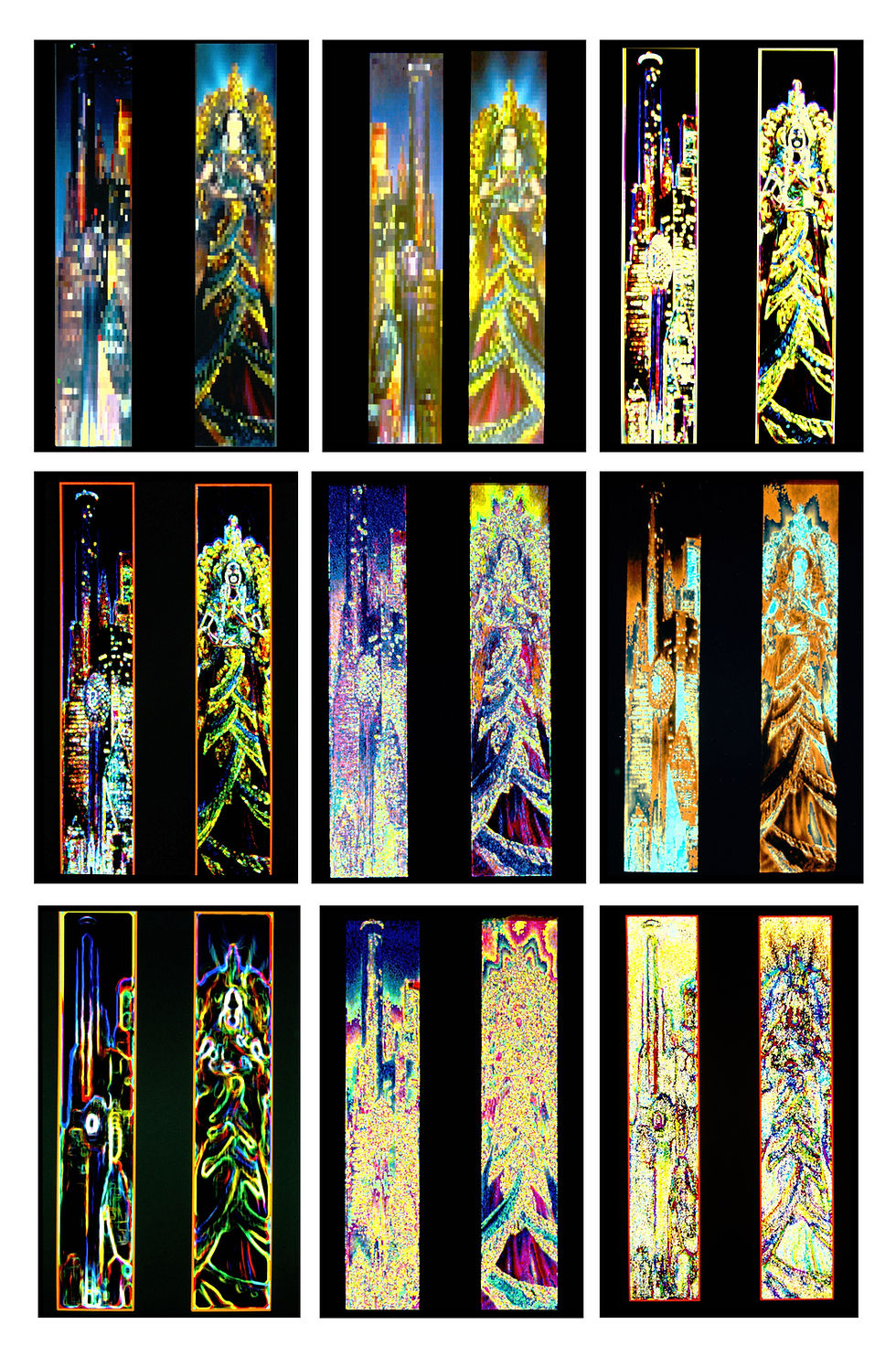
Later, I scanned them to have them digitally processed on Larry’s SGI or Silicon Graphics workstation with an ATT software called RIO, with which we calculated and programmed the digital filters.
As the deadline came to a close, we ran into technical problems.
I had originally intended to make a photomontage of the composition from large color xeroxes of the digital files. However, the rich high-definition images created digitally came out in a lower definition in the 35mm slide output. (see 35mm slides #4 and image #3)
I had to be creative!
In the first step, I followed the plan and produced color xeroxes from the 35mm slides of the digital art. I composed them in a photomontage (see image #3 ), which is the matrix of the final art.
Next, I had a 20” by 24" color print of the original photomontage, also known as a direct color print or DCP. I mounted the print on an illustration board.
With the use of Matte Medium as a base, I was able to retouch the image, which became the art that you see. (see image #2B, #1 & #2)
Each pixel in the "pixely" part of the image was hand-painted in the final artwork during the retouching process.
I did meet the deadline, and everyone at Bantam Books was thrilled with this newfangled "computer illustration."
The initial photomontage was digital, while the finished art, also digital, combined traditional techniques in its finishing touch.
This reflects the osmosis between the real world and the virtual reality of Snowcrash, beyond the intent of the image.
Ironically, it also mirrors the writer's original attempt to create Snowcrash as a digital graphic novel. Writing it as a classic novel instead placed Snowcrash in Time magazine's list of the top 100 books of the twentieth Century in the English language.
Neil Stephenson's visionary dreams have become the future that we live in, with concepts such as augmented reality, Google Earth, and cryptocurrency.
Neil Stephenson brought into the language words such as "Avatar" and "Metaverse". I could have never imagined Snowcrash to become the "1984" of cyberspace.
Jean-François Podevin

computer generated 35mm slides

Original sketch of Ashera

photograph of circuitry

first thumbnail concept sketch of the cover image

detail from the original art

original artwork


Comments